
Mortgage Tech for Enterprise Lenders: Compliance, Integrations & Vendor Qualification
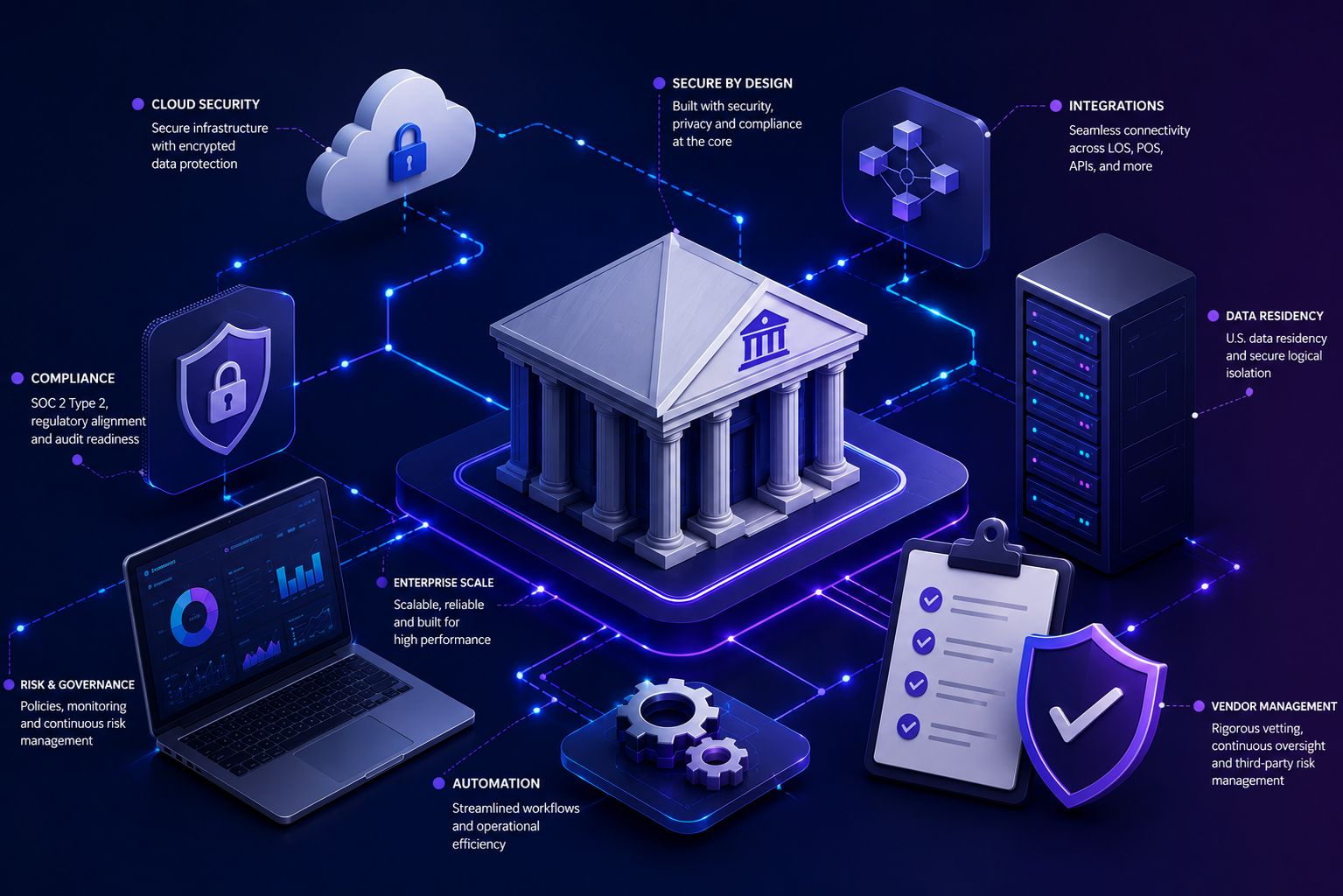
Enterprise-grade lenders — the national banks, the GSEs, the top-25 independent mortgage banks — do not evaluate mortgage tech vendors the way a regional credit union does. The depth of the review, the integration complexity, the compliance expectations, and the commercial terms are different by orders of magnitude. A startup that wins at the regional level can still be disqualified at the enterprise level for reasons that have nothing to do with product quality.
Here is the current shape of the enterprise mortgage tech bar, drawing on the experience of teams that have delivered across 40+ mortgage technology engagements. Every requirement is a gate; miss one and the procurement process stalls.
Compliance Posture: Layered, Not Single-Framework
Mortgage tech operates under a compliance regime that is more layered than most verticals. Federal consumer protection (TILA, RESPA, TRID, HMDA, ECOA, Fair Housing), CFPB-aligned UDAAP guidance, state-level licensing and notification obligations, GLBA for consumer financial data, and if there is any servicing exposure, the additional layers from Regulation X and the CFPB's mortgage servicing rules.
On top of that, the standard enterprise stack — SOC 2 Type 2, ISO 27001 alignment, and an NIST 800-53 moderate baseline for lenders who sell to the GSEs. SOC 2 is the entry ticket. Without SOC 2 Type 2, enterprise lenders cannot even start the substantive compliance review; the vendor risk team will disqualify the package at triage.
The practical consequence: a mortgage tech startup should be thinking about compliance at sprint one, not at the first procurement conversation. Retrofitting regulatory controls onto a live codebase is where most enterprise deals die — not because the product is wrong, but because the compliance surface area is larger than the engineering surface area.
Integration: LOS, POS, Servicing, Secondary
Enterprise lenders run on a stack that includes one or more loan origination systems (LOS) — Encompass, Blue Sage, Lending QB, MeridianLink, Calyx — a point-of-sale (POS) layer facing consumers, servicing platforms, document management, pricing engines, and secondary market platforms for delivery. A new vendor that lands in this stack has to integrate cleanly with at least two of those systems and usually more.
The integration pattern is not standard. Encompass has a modern API and a legacy SDK, with different integration stories for each. Servicing platforms lean on batch files and legacy SOAP. The GSE integrations — Fannie Mae's DU, Freddie Mac's LPA, the Desktop Underwriter and Loan Prospector APIs — each have their own ceremonies and their own test harnesses.
A vendor who cannot describe integration fit in specific vocabulary — adapter architecture, idempotent workflow design, state reconciliation across systems of record — will struggle in the architecture review. Enterprise lenders expect domain depth, not generalist engineering skill.
Data Residency and Tenancy
Enterprise lenders are conservative about where mortgage data lives. Expect U.S. data residency requirements, increasingly explicit cloud region constraints, and occasional requirements for dedicated infrastructure or bring-your-own-cloud (BYOC) deployments. The architecture decision about tenancy — shared multi-tenant, logical isolation, dedicated infrastructure — is not a sales conversation; it is a technical design decision that has to be made before the first lender deal, because retrofitting dedicated tenancy onto a shared schema is an architectural migration.
Similarly, data classification and retention have to be right. Mortgage loan data is GLBA-covered consumer financial data. Retention schedules vary by document type (originating documents vs servicing records vs compliance evidence), and lenders will ask for a schedule that matches their own record retention policy.
Vendor Qualification: The Long Form
Enterprise lender vendor qualification is a long-form exercise. Expect a detailed vendor security questionnaire (often 300+ lines, based on SIG or an internal framework), a financial stability review, a business continuity review, a Patriot Act / AML review on the company and principals, a privacy review, a vendor concentration review, and a model audit alignment review if the lender is subject to NAIC-adjacent or OCC guidance.
Each of those reviews wants evidence. SOC 2 Type 2 covers a meaningful chunk. The rest has to be assembled from documented policies, tested runbooks, audited financials (or a plausible financial statement package), executed DPAs with sub-processors, and a clear articulation of the vendor's own vendor management.
The 12-Month Shape
A mortgage tech startup aiming at enterprise-grade lenders in a 12-month horizon should expect the following shape: months 1–3, compliance-first engineering and SOC 2 pipeline stand-up; months 2–5, core integrations with LOS and GSE APIs built alongside product; months 4–9, SOC 2 Type 2 observation window and evidence accumulation; months 6–12, enterprise design partner engagements with InfoSec and procurement running in parallel; month 9–12, first signed enterprise contract.
That shape is tight. It only works when the engineering, the compliance, and the integration are running in parallel from day one — which is the entire structural reason Engineering in a Box groups those disciplines into a single pod.
Where Reslt AI Plugs In
We have delivered mortgage technology engagements across 40+ companies, including a digital homeownership platform with four portals spanning AI advisors, identity verification, credit bureau integrations, and a lender marketplace. The pattern we run is architecture-led, compliance-first, integration-pragmatic: a US architect who has sat on GSE review calls, a pod that has wired Encompass and DU integrations before, a SOC 2 compliance engineer who has run the pipeline through an enterprise lender's vendor review.
If you are a mortgage tech startup planning to sell into enterprise-grade lenders, the cost of doing this cold is measured in quarters and deals lost. The cost of doing it with a partner who has already walked the path is a different calculus. Results By Design — and for mortgage tech selling into the top of the market, design is compliance, integration depth, and domain fluency bundled into the delivery model.
Talk to Reslt AI
If the path in this piece matches your next 12 months, the Reslt AI team can scope an Engineering in a Box pod around it. SOC 2 Type 2 validated by A-LIGN, a US Solution Architect on every engagement, and a delivery team that has shipped into regulated verticals before — from sprint one. Reach us at contact@reslt.ai or visit reslt.ai.